Strengthening Public–Private Partnerships and Non-State Education Policy in Nigeria
Recognising the critical role of non-state education providers in expanding access to learning opportunities, TEP Centre has been at the forefront of efforts to strengthen Public–Private Partnerships (PPPs) within Nigeria’s education sector. Through the FCDO-funded PLANE programme, the organisation generated robust evidence, facilitated stakeholder engagement, and provided technical support that informed major policy reforms at both federal and state levels.
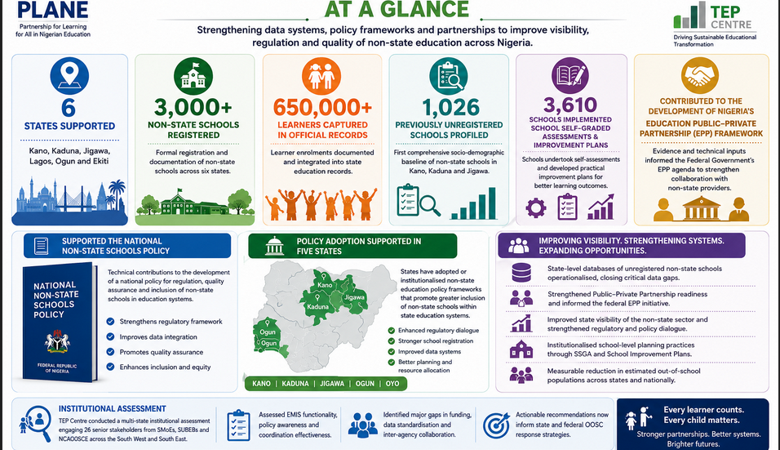
A key achievement of this work was its contribution to the development of Nigeria’s Education Public–Private Partnership (EPP) Framework and the National Non-State Schools Policy. These policy instruments provide a structured approach for collaboration between government and non-state education providers, strengthening governance, accountability, quality assurance, school registration processes, and data integration across the education system.
At the sub-national level, the programme supported policy adoption and implementation efforts in Kano, Kaduna, Jigawa, Ogun, and Oyo States. Through these reforms, state governments have enhanced the recognition and integration of non-state schools into education planning, monitoring, and service delivery frameworks. The policies have also strengthened regulatory dialogue and fostered greater collaboration between education authorities, school proprietors, communities, and development partners.
Beyond policy development, the initiative has contributed to improving the visibility of learners enrolled in non-state schools, many of whom were previously excluded from official education statistics. By strengthening education data systems and supporting the registration of non-state schools, governments now have access to more comprehensive information for planning, resource allocation, and decision-making.
These achievements demonstrate the importance of evidence-based policymaking and multi-stakeholder collaboration in addressing educational challenges. By strengthening PPP readiness and institutionalising supportive policy frameworks, TEP Centre has helped lay the foundation for a more inclusive, accountable, and responsive education system that recognises the contribution of all providers in delivering quality education for every child.
As Nigeria continues its efforts to improve access, equity, and learning outcomes, stronger partnerships between government and non-state actors will remain essential for achieving sustainable and system-wide educational transformation.
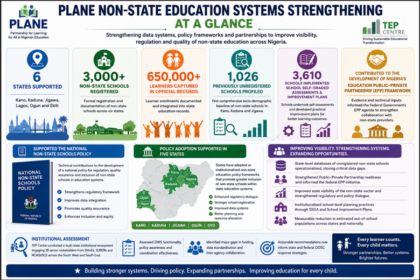
Non-State Education Systems Strengthening: Key Results
Key achievements of the PLANE non-state education programme