
Closing a Foundational Learning Gap in 24 Days: What the Data From Kano and Akwa Ibom Shows
A pilot programme in two Nigerian states offers measurable evidence that foundational learning gaps can be closed quickly, and affordably
A significant proportion of Nigerian primary school children remain unable to read a simple sentence or perform basic arithmetic, despite years of regular school attendance. The Education Partnership (TEP) Centre piloted an intervention designed to test how quickly that gap could be closed. The results, measured directly against the United Nations’ SDG Indicator 4.1.1, offer a clear answer.
The Evidence Behind the Intervention
The pilot was a direct response to findings from the 2017 LEARNigeria household assessment. In Kano, only 6% of boys and 10% of girls in Primary 3 could read at the level expected of a child two years younger. In Akwa Ibom, the figures stood at 20% and 22%.
The data also showed that this gap does not resolve itself over time. By Junior Secondary School 3 in Kano, reading proficiency had risen to only 54% among girls and 31% among boys. Years of additional schooling had not translated into commensurate gains in foundational literacy.
This evidence base, rather than assumption, shaped the design of the LEARNigeria Remedial Programme (LRP).
The Approach: Teaching at the Right Level
LRP was built on Teaching at the Right Level (TaRL), a methodology that begins by assessing each child individually rather than assuming competence based on age or grade. Children are grouped according to their demonstrated skill level, and instruction is tailored specifically to that group.
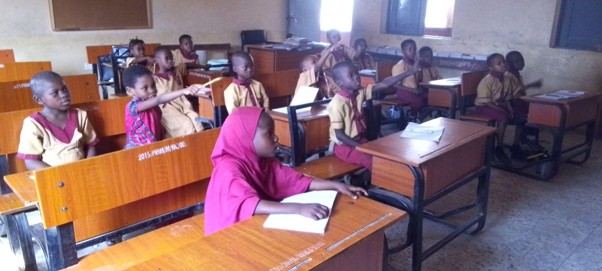
The pilot ran as a holiday programme, 24 days in Kano and 25 days in Akwa Ibom, reaching 679 children in Primary 3 to 5. It was delivered by 42 trained community volunteers using locally sourced, low-cost teaching materials, without requiring new infrastructure or specialist staffing.
Measured Results Against SDG Indicator 4.1.1
The outcomes were assessed using the same diagnostic tool at baseline and endline, with results reported directly against SDG Indicator 4.1.1, the global benchmark for minimum proficiency in reading and mathematics.
In Kano, the proportion of children at beginner reading level, unable to recognise basic syllables, fell from 71% to 34% over 24 days. The proportion reading at full story level, the proficiency threshold under SDG 4.1.1, rose from zero to 7%.
In Akwa Ibom, the proportion of children unable to read letters fell from 36% to 9%. Story-level reading proficiency rose from 17% to 25%, an 8-percentage-point increase within a single 25-day cycle.
Numeracy outcomes followed a similar trajectory. In Akwa Ibom, the proportion of children able to recognise three-digit numbers rose from 54% to 86%. In Kano, the same measure nearly doubled, from 23% to 41%. The proportion of children able to complete two-digit addition problems rose from 11% to 67% in Akwa Ibom, and from 16% to 46% in Kano.
Implications for Programme Design
These results indicate that meaningful progress against SDG 4.1.1 is achievable without significant infrastructure investment or extended implementation timelines. The pilot was delivered at low cost, using community-based volunteer instructors, within a single school holiday period, and without disrupting the regular academic term.
TEP Centre’s internal review identified several areas for strengthening before scaling, including more structured lesson-planning support for volunteer instructors and additional induction and practice time prior to deployment. The organisation has recommended testing an extended, 50-day version of the model within the regular school term, delivered by trained teachers, alongside a formal evaluation of cost-effectiveness ahead of wider rollout.
What the Pilot Demonstrates
With 679 children showing measurable gains in literacy and numeracy proficiency within a single month, the LRP pilot provides direct evidence that Nigeria’s foundational learning deficit can be addressed through targeted, low-cost, evidence-based intervention. The central question for education stakeholders is no longer whether such gains are possible, but how quickly this model can be extended to reach the substantially larger population of children still affected by the same gap.
For more on the LEARNigeria Remedial Programme, or to discuss partnership and scaling opportunities, contact The Education Partnership (TEP) Centre.