
Kano Is Redefining Its Education System by Bringing Non-State Schools Into View
Kano’s education system is evolving. With a large and rapidly growing population, deep levels of poverty, and persistent infrastructure gaps, the system carries pressures that are both structural and immediate. In recent years, these pressures have become harder to ignore. Classrooms have been overcrowded, teaching resources stretched thin, and, in some cases, basic learning conditions simply absent. It is not incidental that the state declared an emergency in the sector, a move aimed at reversing years of decline and restoring some level of stability.
Yet, even within this context, one part of the system has remained largely outside formal view.
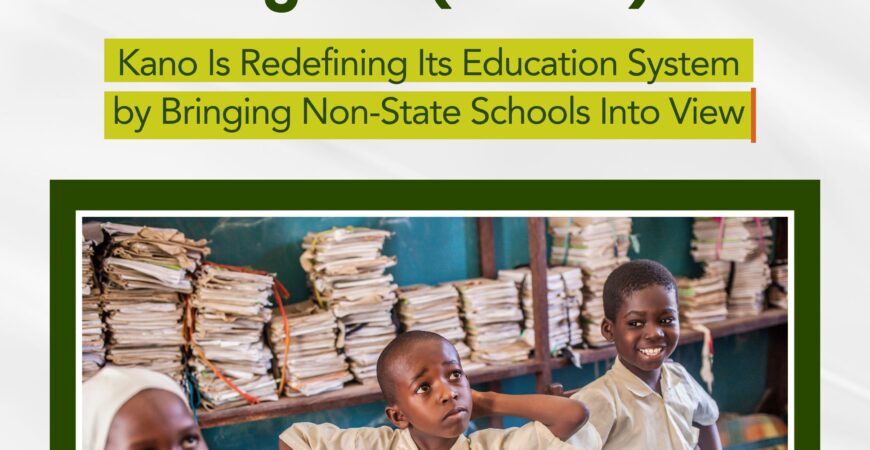
Across Kano, thousands of children attend schools that are not fully captured within government systems. These are run by private individuals, communities, faith-based organisations, and small-scale providers. For many families, they are the most accessible option. For the system, they represent both a gap and an opportunity.
Through our work at TEP Centre on PLANE, this is where our engagement in Kano has focused.
A starting point was simply to understand what exists.
Working with the state, we supported a socio-demographic baseline and graded assessment of unregistered and under-regulated non-state schools. This was not a routine data exercise. It was an attempt to map a part of the system that had long operated without visibility, where many schools were not formally registered, not consistently regulated, and in some cases, not even known to government databases.
What emerged from that work challenged assumptions.
Non-state schools in Kano are not a single category. They vary widely in structure, intent, and quality. Some are small community-run learning centres, others are more formal private schools. Many operate with limited infrastructure and constrained teaching capacity, yet they continue to serve children who might otherwise be out of school. In a state with significant numbers of out-of-school children, this role is not peripheral. It is central to how education is actually delivered on the ground.
This is the context in which the Kano Public-Private Partnership Multisectoral Policy is emerging.
From our perspective, the policy reflects a shift in how the system is choosing to respond. Rather than treating non-state schools as an informal extension to be corrected or shut down, it begins to frame them as actors within the system who need to be engaged, supported, and held to clearer standards.
Our role in this process has been both technical and facilitative.
We have worked alongside state actors to translate evidence from the baseline into policy thinking. This has involved supporting policy design discussions, helping to frame options for engagement, and ensuring that decisions are grounded in what the data is actually showing. It has also meant convening across sectors. Education alone cannot resolve the questions that surround non-state provision. Issues of child protection, community trust, regulation, and even security intersect in ways that require broader coordination.
The policy itself reflects this multisectoral thinking.
It outlines pathways for registration that are more realistic for low-capacity providers. It begins to define how government can support schools to meet minimum standards, rather than only enforcing compliance. It also creates space for structured engagement, where expectations on both sides are clearer.
This matters because the previous equilibrium was not sustainable.
A system where a large number of schools operate outside formal oversight creates risks for children and limits the state’s ability to plan effectively. At the same time, enforcement without viable pathways for schools to improve would likely push many further into informality.
What is emerging instead is an attempt to find a middle ground.
One where visibility increases, standards are gradually strengthened, and support is part of the equation.
From what we are seeing, the expected impact is not immediate transformation, but a shift in how the system functions over time.
First, there is the question of visibility. As more schools are identified and brought into a structured framework, the state gains a clearer understanding of where children are actually learning. This has implications for planning, resource allocation, and policy design.
Second, there is the potential for gradual quality improvement. By creating pathways for schools to move towards minimum standards, the policy opens up the possibility of raising the baseline across a segment of the system that has historically been excluded from formal improvement efforts.
Third, there is a governance shift. Engagement between government and non-state providers becomes less reactive and more predictable. This creates space for accountability, but also for trust to develop over time.
None of this is straightforward.
There are real constraints. Many non-state schools operate with limited financial capacity. State systems themselves are under pressure, with ongoing efforts to rebuild infrastructure, recruit teachers, and coordinate multiple reform initiatives. Even with increased investment and political commitment, challenges around access, materials, and system coherence remain.
This is why the work cannot be reduced to policy alone.
Implementation will depend on how well these ideas translate into practice. It will require continuous engagement, iteration, and adaptation. It will also require recognising that change will happen unevenly, and that progress in one part of the system may not immediately translate to another.
For us at TEP Centre, the work in Kano reflects a broader principle within PLANE.
Education systems are rarely as neat as policy frameworks suggest. They are shaped by how families make choices, how communities organise themselves, and how institutions respond to constraints. Effective reform starts from that reality, not from an idealised version of the system.
In Kano, that reality includes non-state schools.
Bringing them into view is a first step. Building a system that can work with them, improve them, and ultimately deliver better learning for children is the longer journey.
That is the work that is now underway.