
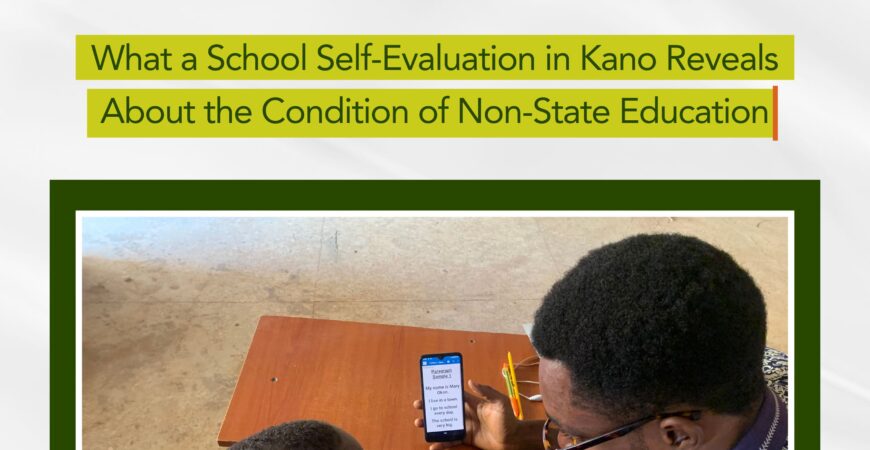
Our Work on PLANE: What a School Self-Evaluation in Kano Reveals About the Condition of Non-State Education
In Kano State, education does not follow a single pattern. It spans different school types and learning environments, shaped by varying community needs and constraints. Conventional private schools, Islamic integrated schools, and Islamic non-integrated schools each play distinct roles within this landscape. What brings this complexity into sharper focus is when schools are supported to assess their own performance in a structured and honest way.
That is what this recent school self-evaluation process set out to do.
Conducted across non-state schools in Kano under the Partnership for Learning for All in Nigeria (PLANE), the assessment offers something more valuable than a compliance exercise or a snapshot of administrative performance. It offers insight into how schools function day to day, where they are coping, where they are improving, and where the gaps remain most urgent. For The Education Partnership (TEP) Centre, which supported the study design, data collection, and reporting process, this work reflects a core belief: meaningful education reform begins with usable evidence, local ownership, and a practical understanding of how schools actually operate.
A closer look at a complex ecosystem
The assessment covered 265 non-state schools across Kano State, drawn from an initial sample of 300 schools across 11 PLANE local government areas. These schools reflect the complexity of the non-state sector in northern Nigeria. About 41% of the assessed schools were conventional private schools, nearly 55% were Islamic integrated schools, and a smaller but important proportion, 4.5%, were Islamic non-integrated schools.
Ownership patterns reveal just how varied this sector is. While 38.5% of the schools were run by single private owners, a similarly large share fell into an “other” ownership category, largely made up of community-linked and Islamic integrated providers. Religious foundations also played a substantial role. This matters because it reminds us that non-state education is not a uniform market. It is a mixed ecosystem shaped by faith, community initiative, private investment, and local demand. Any attempt to improve quality in this sector must begin by recognising that diversity rather than flattening it.
Demand is high, and uneven pressures are visible
One of the most striking findings from the assessment is the sheer scale of enrolment. Across the 265 schools, total enrolment stood at 182,130 learners. Islamic integrated schools accounted for the highest number of students, with 95,396 enrolled, followed by conventional schools with 80,657 and Islamic non-integrated schools with 6,077.
These figures speak to the importance of non-state schools as major providers of education in Kano. They are not peripheral actors. They are central to the state’s education landscape.
The enrolment data also highlights an important gender pattern. Female enrolment was higher than male enrolment across most levels of schooling, with the exception of Upper Basic and Post Basic, where boys slightly outnumbered girls. This is encouraging in one sense, but it also raises deeper questions. Why do girls appear to enrol in relatively stronger numbers at earlier stages, only to lose ground later? Where are the transition points at which participation shifts? And what social, economic, or institutional factors are shaping those patterns?
These are not questions the numbers answer on their own, but they are exactly the kind of questions a strong self-evaluation process should provoke.
What the data says about teachers
No education system can rise above the strength of its teaching workforce, and here too the report presents a mixed picture. Across all school types, the Nigeria Certificate in Education (NCE) was the most common teacher qualification. This suggests that many schools are drawing on the recognised minimum qualification for teaching, which is important. At the same time, degree holders were more concentrated in conventional schools, while Islamic integrated and Islamic non-integrated schools had fewer teachers with advanced qualifications.
The teacher-pupil ratios are especially revealing. Conventional schools had a ratio of about 1 teacher to 59 pupils, while Islamic integrated schools had roughly 1 to 96, and Islamic non-integrated schools about 1 to 76. Even allowing for possible reporting inconsistencies in how ratios were described, the overall message is clear: teacher availability is stretched, especially in Islamic integrated schools, where enrolment is highest.
This is more than a staffing issue. It affects instructional quality, individual attention, classroom management, and ultimately learning. When teachers are overstretched, even a committed workforce struggles to deliver the kind of responsive, high-quality teaching that foundational learning requires.
There is also an important inclusion dimension. The report identified 72 teachers with disabilities across the sample, most of them in conventional schools and some in Islamic integrated schools, with none recorded in Islamic non-integrated schools. That absence points to a gap not only in hiring practices but potentially in broader attitudes and support systems around inclusive employment in education.
Infrastructure tells its own story
If enrolment figures show demand, infrastructure data shows the strain that demand places on schools.
In sanitation, the disparities are stark. Conventional schools had far better toilet availability than the other categories, while Islamic non-integrated schools were operating with extremely limited facilities. The learner-to-toilet ratio was particularly severe in Islamic non-integrated schools, pointing to challenges that affect not only health and dignity, but also attendance and school safety—especially for girls.
Water access is another concern. Boreholes were the most common water source overall, but more than half of the schools reportedly had no water source at all. That is a striking figure. Access to water is not an optional extra in a school environment; it underpins hygiene, sanitation, and basic functionality. The gaps were especially pronounced among Islamic integrated and Islamic non-integrated schools.
Electricity access showed similar patterns. A large number of schools, especially Islamic integrated schools, reported having no source of electricity. Some relied on the national grid, others on generators or limited solar supply, but the overall picture is one of inconsistency and deprivation. In practical terms, this affects everything from lesson delivery to school administration, safety, and the use of educational technology.
School fencing, too, emerged as a significant issue. Many schools—particularly Islamic integrated and non-integrated schools—lacked adequate fencing. In a context where school safety is an ongoing concern, this is not a minor infrastructure gap. It is directly tied to protection, safeguarding, and the creation of a secure learning environment.
Classroom space adds another layer to the story. Conventional schools had a learner-classroom ratio of 81, compared with 119 in Islamic integrated schools and 113 in Islamic non-integrated schools. Overcrowding is not just about discomfort. It affects concentration, teacher effectiveness, ventilation, movement, and the ability to manage learning well. When classrooms are too full, quality inevitably suffers.
What schools say about themselves, and what validation confirms
Perhaps the most valuable part of the exercise lies in the school self-evaluation itself. Schools were assessed across a wide range of operational and educational areas, from leadership and governance to learner safety, attendance, teacher development, classroom environment, curriculum use, and community relationships. They were then graded into four categories: Emerging, Enhancing, Establishing, and Excelling.
The results are sobering.
In the schools’ own self-assessments, 52.5% fell into the Emerging category, 26.0% into Enhancing, 17.7% into Establishing, and only 1.1% into Excelling. But when validators independently assessed the schools, the picture became even more cautious: 61.1% were rated Emerging, 29.1% Enhancing, 7.2% Establishing, and none were rated Excelling.
That gap matters. It suggests that even where schools see themselves as making progress, external validation often reveals weaker systems than internal perceptions might suggest. But this should not be read only as a negative. It shows why structured validation matters. Honest improvement depends on credible evidence, not just aspiration.
The results also identify patterns in school strengths and weaknesses. Areas such as supervision during playtime, learner attendance, teacher attendance, pastoral care, and lesson timing showed relatively stronger performance in parts of the sample. These are signs that many schools are managing routine operations with real commitment, often under difficult conditions.
But the weaker areas are equally telling. Systems for lesson observation were among the poorest-rated areas. External teacher development was limited. Child protection was weak in far too many schools. Co-curricular activities were underdeveloped. School development planning was often poor. Learner participation in school governance was limited. Community relationships were fragile. Use of curriculum and learning materials also showed significant room for improvement.
Taken together, these findings paint a picture that is both challenging and hopeful. The schools are not failing in every area. Many are functioning, often through effort and improvisation. But too many are operating without the systems, support, and resources needed to move from basic functionality to sustained quality.
Why self-evaluation matters
One of the most important lessons from this work is that self-evaluation is not just a reporting tool. Done well, it is a developmental tool. It helps schools name their reality, compare perception with evidence, and create a basis for improvement planning. It encourages ownership rather than passive compliance. It also creates an entry point for dialogue between schools, government, communities, and support organisations.
That is especially important in the non-state sector, where schools are often highly varied, lightly supported, and unevenly regulated. A one-size-fits-all reform approach is unlikely to work. But a structured self-evaluation process can help schools identify the specific improvements they need, and help policymakers understand where support should be targeted.
For TEP Centre, this is where the value of evidence-driven reform becomes tangible. Data is most useful not when it sits in a report, but when it helps institutions act differently. In this case, the findings provide a clear basis for school improvement plans, targeted capacity strengthening, and more grounded decision-making across the sector.
What comes next
The report points toward the next logical step: translating findings into School Improvement Plans. That shift—from diagnosis to action—is where this work will either gain momentum or stall.
The priorities are clear. Schools need better infrastructure, especially classrooms, toilets, water, fencing, and electricity. They need more equitable teacher deployment and stronger professional development. They need better systems for quality assurance, lesson observation, curriculum delivery, and safeguarding. They need stronger relationships with communities and more inclusive approaches to gender and disability. And they need support to move beyond reactive management toward deliberate, strategic school improvement.
But this is not simply a list of deficits. It is a roadmap. The purpose of an assessment like this is not to rank schools for its own sake, but to help schools improve from where they are.
A wider lesson for education reform
There is a broader lesson here for anyone working in education systems reform. Improvement does not begin with assumptions. It begins with disciplined listening—to data, to schools, and to the realities of implementation. In Kano, this self-evaluation process has shown that non-state schools are carrying a significant share of the education burden, often with limited resources and uneven support. It has also shown that many of the barriers to quality are systemic, not merely institutional.
That matters because it shifts the conversation. Instead of asking whether these schools are good or bad, the better question is: what conditions would allow them to do better?
The answer, at least in part, is visible in this report. Better support. Better planning. Better accountability. Better infrastructure. Better teacher development. And a more honest, evidence-based culture of continuous improvement.
That is the real promise of this work on PLANE. Not just that it describes the current state of non-state education in Kano, but that it gives schools, partners, and policymakers a clearer starting point for change.